

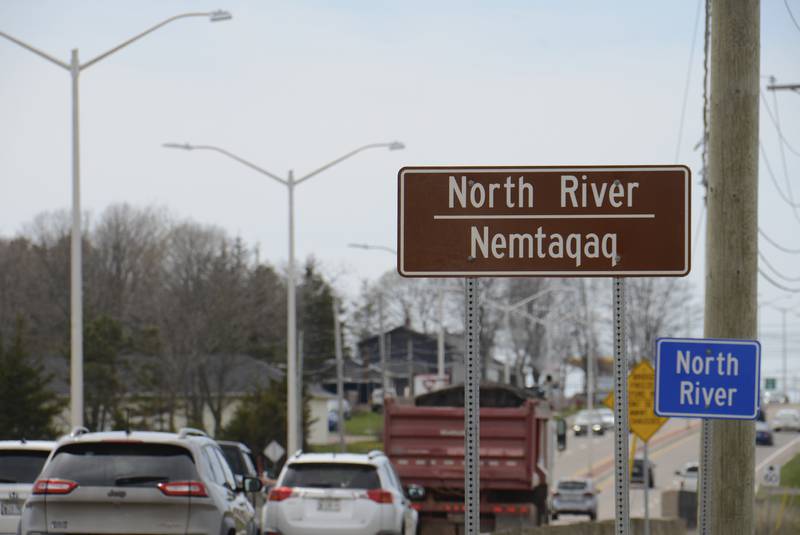
Nine new bilingual signs are now guiding travellers on P.E.I. roads to traditional Mi’kmaq places.
L’nuey, pronounced “UL-nuay”, is an initiative focused on protecting, preserving and implementing the rights of the Mi’kmaq of P.E.I.
The group unveiled the new roadsigns in time for Aboriginal Awareness Week, May 19-22.
“It’s embracing the culture of the people who were here for at least 12,000 years. So it’s great to see,” said Sean Doke, junior communications officer with L’nuey.
At a glance:
Nine new signs are in place around P.E.I. with English and Mi’kmaq place names. Mi’kmaq names are rooted in a description of that specific place or the activities that would take place there. Here’s what they mean:
- Tignish River – Mta’ganejk – “paddle place”
- Portage – Unikansuk – “portage trail”
- Crapaud -Telisipk – “the place where it stretches out”
- Tracadie – Tlaqatik – “the place where people gather”
- Borden – Pastuekati – “a place where seacows are plentiful”
- Fox River – Wokwisewey Sipu – “fox river”
- North River – Nemtaqaq – “being able to see straight up or along until disappearing from view”
- Panmure Island – Kwesoqamkiaq – “sand bar”
- Grand River – Amasisipukwek – “the river where it stretches out and follows far into the distance”
The signs were produced and installed with help from the provincial government and installed in well-travelled areas.
“They’re also places that served a historic significance to the Mi’kmaq in one way or another, whether that be traditional fishing grounds, hunting grounds, campsites, you name it,” said Doke.
“It’s a great way for the general public to learn a little bit of Mi’kmaq.”
Seeing the bilingual signs appear was rewarding, said Doke, who has Mi’kmaq roots on Lennox Island.
The place name project started back in 2005 at the Mi’kmaq Confederacy.
As they worked, interviewers asked for any Mi’kmaq place names on P.E.I. people could remember.Historian and archivist Tammy MacDonald started collecting place names while staff members were researching land use and gathering knowledge from elders.
“We also had access to transcriptions of interviews that had taken place with P.E.I. Mi’kmaq elders in the 1990s and interviews with both Acadian and Irish P.E.I. community members in the 1980s and ’90s,” said MacDonald in an email.
“We were able to find a few more that way.”
The crew also consulted maps, books and other historical documents, said Doke.
In 2007, MacDonald’s team sent a list of more than 200 places to linguist Stephanie Inglis, PhD, director of the Unamaki’k College Kji-keptin Alexander Denny L’nui’sultimkeweyo’kuom (Mi’kmaq Language Lab) at the Cape Breton University.
Did you know?
Orthography refers to a standard representation of a language in written or printed symbols. The Mi’kmaq language has several different orthographies; the Francis-Smith Orthography was developed by Bernard Francis and Douglas Smith in 1980. It is used by people in Nova Scotia, Newfoundland, Prince Edward Island and parts of New Brunswick. It is also the official orthography of the Mi’kmaq Sante’ Mawio’mi (Grand Council).
Many of the place names had several spellings, so Inglis converted them to Smith-Francis orthography, the most common way of spelling out words in the Mi’kmaq language.
“Once the list was completed, it was then shared wth an anthropologist to provide some cultural framework to the final 120 Mi’kmaq place names that were unique to P.E.I. that they’d found,” said Doke.
The names have been used in grade school curricula and other projects as well as the road signs since the list was created.