

The historic Peace and Friendship Treaties between the Mi’kmaq and the Crown guarantee the Mi’kmaw right to hunt, fish, gather, and earn a reasonable living, and still stand today.
History of the treaties
The Mi’kmaq relationship with the French and the Acadians, starting when they first arrived on these shores, was one of mutual respect and military alliance. The military alliance was believed to be necessary because of the long-standing pattern of peace and conflict between the British and the French. However, the British viewed their relationship with the Mi’kmaq as one that needed a more formal approach.
It must be remembered that while these treaties were entered into, the Mi’kmaq were never conquered, and never surrendered, gave up or ceded their land. Mi’kma’ki is still Mi’kmaw territory.
1725–1752 — Series of Peace and Friendship Treaties signed between the British and the Mi’kmaq. The Mi’kmaq agreed to cease hostilities; the British agreed not to interfere with Mi’kmaw hunting, fishing, and harvesting throughout Mi’kma’ki.
1760–1761 — Following the Seven Years’ War, Chief Baptist La Morue of Epekwitk traveled to Halifax with other Mi’kmaw Chiefs to sign a final series of treaties, guaranteeing the Mi’kmaw right to hunt, fish, gather, and earn a reasonable living without British interference.
1999 — The Marshall Decision: the Supreme Court of Canada recognized and affirmed a treaty right to hunt, fish, and gather in pursuit of a moderate livelihood, arising from the 1760–61 Treaty of Peace and Friendship.
Today — The treaties remain in force. Every October 1, Treaty Day marks the official recognition of this enduring relationship. We are all treaty people.
Understanding the Peace and Friendship Treaties
To learn more about the history and significance of the Peace and Friendship Treaties, download L’nuey’s research paper.
Aboriginal & Treaty Rights
Aboriginal and Treaty Rights are living rights, protected in Canada’s Constitution, and central to the Epekwitnewaq Mi’kmaq’s role as the original stewards of this land.
Treaty Protected Fishery
The Mi’kmaq right to fish on Epekwitk is older than Canada itself. Learn the story of the Treaty Protected Fishery and what it means for our shared future.
Treaty Day
Each year on October 1, we celebrate Treaty Day, the official recognition of the Peace and Friendship Treaties that still stand today.
Podcast Episode
Mi’kmaq History Month Edition: Treaties of Peace and Friendship
L’nuey Communications Officer Sean Doke speaks with colleague Annie Martin to delve into some of the history behind the Peace and Friendship Treaties that were signed between the Mi’kmaq and the Crown, and why they are still relevant today.
Special Thanks
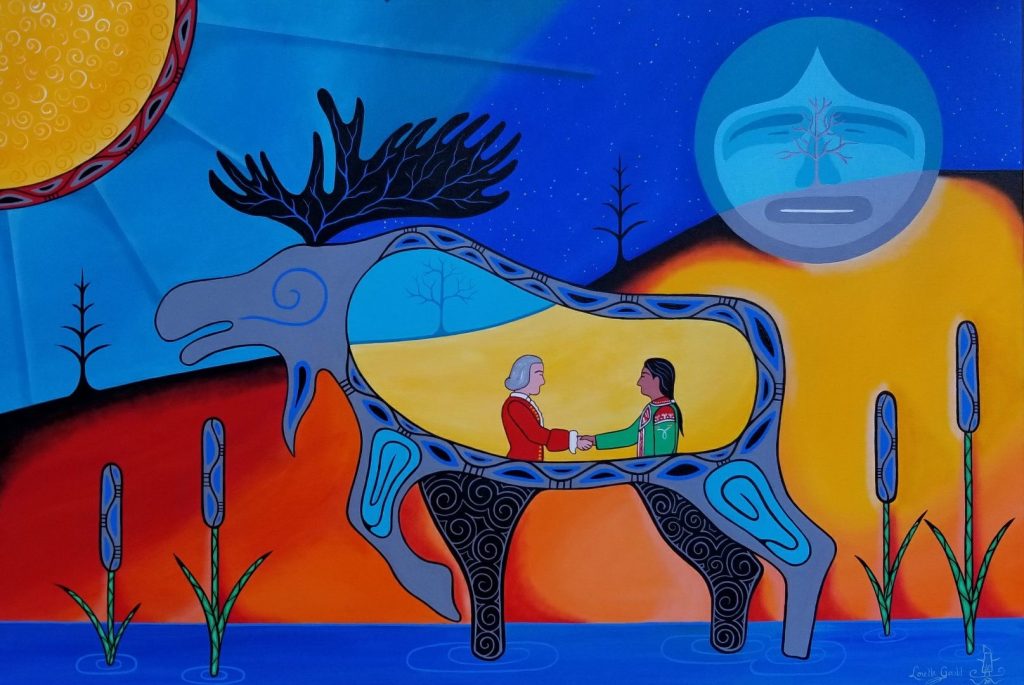
Loretta Gould
L’nuey was fortunate to collaborate with Mi’kmaq artist Loretta Gould in the creation and inspiration of images used in the Treaty Day video, print and digital communications. Loretta’s art is spiritual and her love of bright, beautiful colours is evident in her work. Her images each tell a story of Mi’kmaq life and serve as historical snapshots. Loretta created this piece as a centrepiece image that inspired the video’s animators, with the symbolism and bold imagery serving as the campaign’s signature.